Johanson CapStrate® Technology for Pulsed-Power Detonator Systems
Fast, Controlled Energy Delivery for EBW, EFI, and Pulsed-Power Initiation Systems
Key Takeaway:
Need faster current rise time in a pulsed-power initiation system?
CapStrate® is Johanson's custom, low-inductance technology designed to minimize discharge-path inductance, enabling faster current rise (di/dt), improved timing precision, and more reliable energy delivery for EBW, EFI, EED, and other high-current pulsed-power applications.
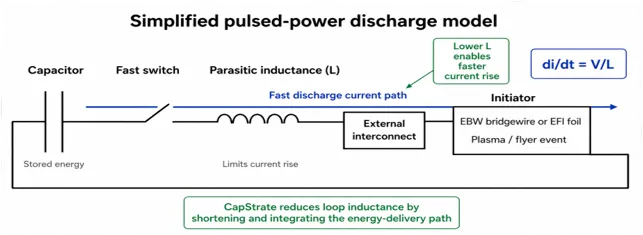
Simplified discharge model showing how parasitic inductance in the firing circuit limits current rise.
Executive Summary:
Advanced pulsed-power initiation systems, including Exploding Bridgewire (EBW) and Exploding Foil Initiator (EFI) technologies, require more than energy storage. System performance depends on how quickly, efficiently, and predictably that energy reaches the initiator.
Parasitic inductance within the capacitor discharge path can restrict current rise rate (di/dt), resulting in reduced timing precision, inconsistent initiation, and less predictable energy delivery.
CapStrate® addresses these challenges by minimizing discharge-path inductance and shortening the current-loop length. Compared with traditional discrete capacitor networks, CapStrate® supports:
- Faster current rise
- More precise timing
- More controlled energy delivery
- Improved initiation repeatability
- Greater reliability in high-current pulsed-power systems
Pulsed-Power Initiation Systems: Common Requirements
CapStrate® is well suited to EBW, EFI (slapper), and related pulsed-power initiation systems requiring fast, controlled energy delivery.
Despite differences in architecture, these systems share a common bottleneck: the ability to deliver energy rapidly and predictably to the initiator. In practice, inductance directly limits current rise rate (di/dt), making circuit geometry a critical design constraint.
- Fast current rise rate (di/dt)
- Low inductance (L)
- Controlled, repeatable energy delivery
di/dt = V / L
In pulsed-power firing systems, the capacitor discharge unit (CDU) and the interconnect path to the initiator strongly influence current rise rate and energy-delivery efficiency.
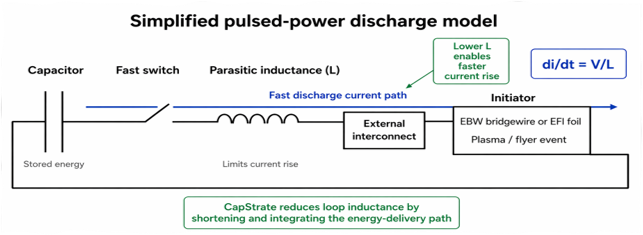
Figure 1. Simplified discharge model showing how parasitic inductance in the firing circuit limits current rise.
Reducing L allows the capacitor to deliver current more rapidly into the initiator.
While inductance plays a dominant role in limiting current rise rate, discharge behavior is more accurately described by the full RLC response of the circuit, including contributions from:
- Capacitor ESR and ESL
- Switching device characteristics (e.g., spark gap, solid-state switch)
- Interconnect geometry
- Initiator impedance
Reducing loop inductance, especially within the capacitor network and immediate discharge path, remains a primary lever for improving current rise time and waveform consistency.
Exploding Bridgewire (EBW) and Exploding Foil Initiators (EFI)
Exploding Bridgewire (EBW)
EBW detonators use a high-voltage capacitor discharge to rapidly heat a fine wire, causing it to vaporize into plasma and initiate the explosive. Reliable operation depends on delivering sufficient energy within a very short time window to achieve consistent bridgewire burst and plasma formation.
Exploding Foil Initiators (EFI / Slapper Detonators)
EFI systems operate on a similar pulsed-power principle but use an exploding foil to generate plasma that accelerates a small flyer into the explosive. Compared with EBW, EFI systems typically demand even higher current rise rates, tighter control of pulse shape, and greater consistency in the discharge path.
Why Discrete MLCC Networks Become a Bottleneck
Traditional capacitor-discharge units (CDUs) are often implemented as arrays of discrete multilayer ceramic capacitors (MLCCs) interconnected through PCB traces. While effective in many circuits, this approach introduces parasitic inductance, distributed current paths, and layout-dependent variability. Multiple solder joints also increase mechanical vulnerability under shock and vibration. Together, these factors can reduce current rise rate (di/dt) and increase timing uncertainty in pulsed-power initiation systems.
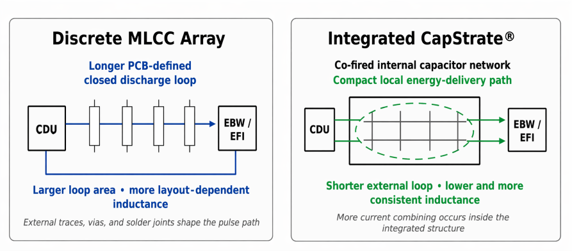
Figure 2. Conceptual comparison of discharge-loop geometry and loop area. A discrete MLCC array relies on a longer PCB-defined loop with more external interconnects, while CapStrate® integrates the capacitor network into a compact structure that shortens the external loop and improves inductance consistency.
CapStrate® Technology: Integrated Energy Delivery
CapStrate® replaces discrete capacitor networks with a co-fired multilayer ceramic structure that integrates capacitive elements, electrodes, and interconnects into a single device. This architecture minimizes current loop length, reduces parasitic inductance, and creates a more controlled electrical geometry for consistent energy delivery.
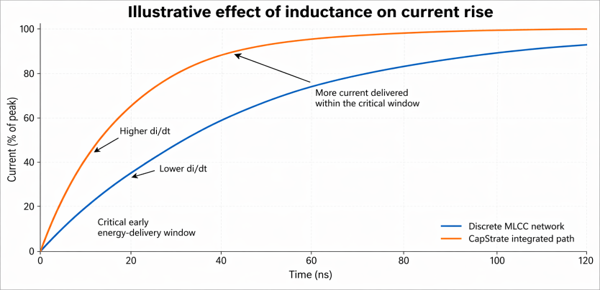
Figure 3. Illustrative current-rise comparison for a discrete MLCC network versus an integrated CapStrate® path.
Performance Advantages in EBW and EFI Systems
| Capability | System-Level Benefit |
|---|---|
| Improved current rise rate (di/dt) | Supports faster bridgewire burst and more consistent foil explosion or flyer acceleration |
| Controlled energy delivery | Improves repeatability of the initiation event and reduces waveform variability. |
| Enhanced timing precision | Lower, more consistent inductance helps reduce timing spread between channels. |
| Mechanical robustness | Monolithic ceramic construction reduces solder-joint count and improves shock/vibration resistance. |
| Compact, application-specific form factors | Designed to optimize size, weight, and power (SWaP) in tightly constrained system layouts. |
Beyond EBW and EFI: Broader Pulsed-Power Applications
CapStrate® technology is also relevant to other pulsed-power initiation and ignition systems where low inductance and fast, controlled energy delivery are critical. Examples include advanced electro-explosive devices (EEDs), multi-point initiation systems requiring synchronized firing, and other high-current pulsed ignition circuits.
Why Johanson
Johanson is a trusted manufacturer of high-voltage capacitors and energy storage solutions for EBW, EFI, pulsed-power initiation systems, detonator circuits, and high dV/dt applications.
- U.S. based manufacturer with North American production
- 60+ years of capacitor design and manufacturing expertise
- ITAR-compliant, AS9100-certified, and ISO 14001-certified facilities
- Custom capacitor design support for defense and high-reliability programs
- MIL-STD screening and advanced reliability testing
- Flexible ceramic formulations tailored to application requirements
- BME and PME manufacturing capabilities
- High-energy-density CapStrate® technology for rapid energy discharge
- Optimized for Exploding Bridge Wire (EBW), Exploding Foil Initiator (EFI), and pulsed-power initiation systems
- Long-term program support, traceability, and process control for mission-critical applications
Conclusion
As detonator technologies evolve toward higher precision, greater safety, and operation in harsher environments, the capacitor discharge network increasingly becomes a limiting factor. By integrating energy storage and delivery into a low-inductance, controlled-geometry ceramic structure, CapStrate® enables faster current rise, improved timing precision, and greater reliability for EBW, EFI, and related pulsed-power initiation systems.
Talk to our technical team about your pulsed-power design: https://www.johansondielectrics.com/contact/ask-a-question/
What is CapStrate® technology?
CapStrate® is a ceramic-based capacitor substrate technology that integrates multiple capacitive elements into a single co-fired ceramic structure. This design provides compact, low-inductance energy storage for applications that require rapid and controlled energy delivery.
What are pulsed-power detonator systems?
Pulsed-power detonator systems use stored electrical energy that is released in a very short time to initiate an event. Examples include Exploding Bridgewire (EBW) detonators and Exploding Foil Initiators (EFI), both of which rely on fast and repeatable capacitor discharge performance.
Why is low inductance important in pulsed-power applications?
Inductance limits how quickly current can rise in a discharge circuit. Lower inductance enables faster current rise rates (di/dt), which helps deliver energy more efficiently and consistently to the initiator.
How does CapStrate® improve pulsed-power system performance?
By integrating capacitance directly into a ceramic substrate, CapStrate® reduces parasitic inductance associated with discrete capacitor networks and interconnects. This helps improve current delivery, pulse consistency, and overall system reliability.
What challenges do traditional MLCC capacitor networks present?
Arrays of discrete multilayer ceramic capacitors (MLCCs) typically require PCB traces and interconnects that add parasitic inductance and complexity. These factors can reduce discharge efficiency and create variations in pulse performance.
Is CapStrate® suitable for EBW and EFI detonator designs?
Yes. CapStrate® is specifically suited for EBW, EFI (slapper), and related pulsed-power initiation systems that require fast, predictable energy delivery and low-inductance discharge paths.
What are the benefits of integrating capacitance into the substrate?
Integrated capacitance can reduce component count, save board space, simplify assembly, improve reliability, and help optimize high-speed pulse discharge performance.
Can CapStrate® be customized for specific applications?
Yes. CapStrate® solutions can be tailored with custom sizes, capacitance values, voltage ratings, and metallization patterns to meet unique application requirements.
What industries can benefit from CapStrate® technology?
CapStrate® is well suited for aerospace, defense, and other high-reliability applications where precise, repeatable pulsed-power performance is required.
Where can I learn more about CapStrate® solutions?
For detailed technical information and application support, contact Johanson Dielectrics or consult the complete CapStrate® technical resources and design guides available from Johanson.